
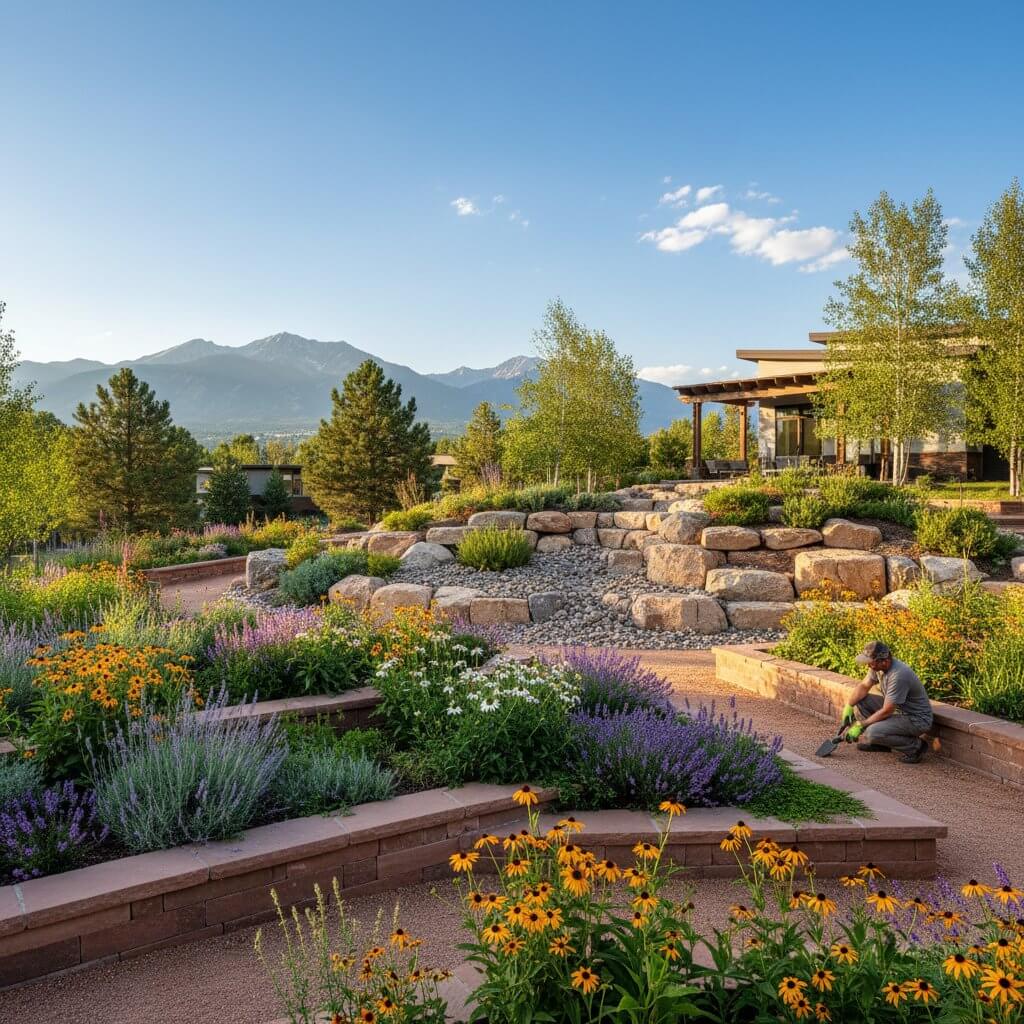
Landscaping in Denver requires more than choosing plants and materials based on appearance. The region’s dry climate, variable temperatures, clay-heavy soils, intense sun, and seasonal weather changes can all affect how well a landscape performs.
Homeowners, landscapers, contractors, and property managers can improve project results by selecting materials that match local soil conditions and the intended use of each area. ARS Landscape Materials & Supply provides compost, fill dirt, garden mix, planter’s mix, and other landscape materials for projects throughout the Denver metro area.
Key Takeaways
- Denver landscapes must account for dry conditions, soil variability, drainage, and changing seasonal temperatures.
- Compost can improve existing soil by adding organic matter.
- Fill dirt is better suited to grading, leveling, and elevation changes than plant growth.
- Garden mix provides a growing medium for vegetable gardens, flowers, and planting beds.
- Planter’s mix can support trees, shrubs, grass, and broader landscape planting areas.
- Choosing materials based on the project’s function can reduce unnecessary costs and improve long-term performance.
Why Local Landscaping Conditions Matter in Denver
A landscape that performs well in one region may require a different approach in Denver.
Colorado’s semi-arid conditions mean water management is an important part of planning. Plants may experience periods of heat and limited rainfall, while soil conditions can make irrigation either drain too quickly or remain trapped around roots.
Many Denver-area properties also contain clay-heavy or compacted soils.
Clay soils can become dense when dry and sticky when wet. Construction activity can further compact soil, reducing the pore space roots needed for air, water, and expansion.
Understanding these conditions before installing plants or ordering landscape materials helps prevent avoidable problems.
Instead of asking which soil product is generally “best,” determine what the site actually needs. A vegetable garden, tree planting area, low section of a yard, and grading project all require different materials.
Start by Evaluating Existing Soil
Before adding new soil or amendments, examine what is already present.
Soil texture, drainage, compaction, depth, and organic matter can influence which material will provide the greatest benefit.
If existing garden soil has sufficient depth but appears low in organic matter, compost may be useful. If you are creating an entirely new planting bed, garden mix may provide a better foundation.
Areas that need substantial elevation changes may require fill dirt underneath the final planting layer.
|
Existing Condition |
Material to Consider |
Main Purpose |
|
Low organic matter |
Compost |
Improve existing soil |
|
Poor garden soil |
Garden mix |
Create a better growing medium |
|
New tree or shrub area |
Planter’s mix |
Support landscape planting |
|
Low or uneven ground |
Fill dirt |
Raise and level the site |
|
Major grade change |
Fill dirt |
Establish lower structural layers |
The correct choice also depends on drainage and the final use of the area.
Improve Existing Soil with Compost
Organic matter plays an important role in healthy garden soil.
ARS Compost can be incorporated into existing beds where soil structure or organic matter needs improvement.
Compost can help make dense soil more workable while supporting biological activity and nutrient cycling. In faster-draining soil, organic matter can also help improve moisture retention.
For Denver gardens, these qualities can be particularly useful because soil often needs to manage both dry weather and irrigation efficiently.
Compost should generally be used as an amendment rather than as the only growing medium.
If your soil already contains adequate mineral material and planting depth, incorporating a moderate amount of compost may be more appropriate than replacing the entire bed.
Use Fill Dirt for Grading and Leveling
Not every landscaping project requires nutrient-rich soil.
When the primary goal is raising ground elevation, filling depressions, reshaping a slope, or correcting uneven terrain, filling dirt is usually more appropriate than premium planting soil.
ARS Fill Dirt can provide the lower material needed for grading projects.
Because fill dirt contains less organic matter than planting soil, it is generally more suitable for applications where stability is the main priority.
A common landscape project may use different materials in layers.
For example, fill dirt can be used to raise a low section of a yard. Once the correct grade is established and compacted, suitable planting soil can be placed near the surface for grass or other vegetation.
This approach allows each product to perform the job it was designed for.
Create Better Planting Areas with Garden Mix
New garden beds need a soil environment that supports root development, drainage, moisture retention, and nutrient availability.
ARS Garden Mix provides a blended growing medium for vegetable gardens, flower beds, raised beds, and other planting areas.
Garden mix combines mineral soil and organic material, giving it a different purpose from compost alone.
This can make it useful when the existing soil is too poor, shallow, or compacted to serve as the primary growing medium.
When installing garden mix over existing ground, prepare the site first.
Remove debris and weeds, and consider loosening the upper surface of heavily compacted soil. Creating a transition between the new soil and the layer underneath can help roots move beyond the newly installed material.
Choose Planter’s Mix for Trees, Shrubs, and Grass
Broader landscape planting areas may have different needs from vegetable or flower gardens.
Planter’s mix can be useful for projects involving trees, shrubs, grass, and general landscape planting where a balanced soil layer is required.
Trees and large shrubs should still be planted according to proper horticultural practices.
Adding premium soil only to a small planting hole surrounded by compacted native soil can create an abrupt change in soil conditions. Root development and drainage should be considered across the larger planting area.
The final grade also matters.
Trees and shrubs placed in low areas may experience excessive moisture even when high-quality soil is used.
Account for Denver’s Water Challenges
Water efficiency is an important part of landscaping in Colorado.
The right soil can help, but irrigation practices still need to match the plants and site.
Soil containing appropriate organic matter can help retain moisture, while good structure allows water and air to move through the root zone.
However, adding soil amendments cannot fix every drainage problem.
If water consistently collects in one location after rain or irrigation, grading may need to be corrected before new planting material is installed.
Plants should also be grouped according to similar watering requirements where practical.
This makes it easier to irrigate according to plant needs instead of applying the same amount of water throughout the entire property.
Match Landscape Materials to the Project
A simple way to avoid unnecessary expense is to choose materials according to function.
|
Project |
Material to Consider |
Priority |
|
Vegetable garden |
Garden mix |
Root growth and soil quality |
|
Flower bed |
Garden mix or amended soil |
Growing conditions |
|
Existing garden improvement |
Compost |
Organic matter |
|
Tree and shrub planting |
Planter’s mix |
Root establishment |
|
Lawn preparation |
Appropriate planting soil |
Surface growing layer |
|
Filling a low area |
Fill dirt |
Elevation and stability |
|
Grading a property |
Fill dirt |
Site shape and compaction |
Using garden mix several feet deep beneath a grading project may add unnecessary expense. Likewise, placing ordinary fill dirt where vegetables will grow may create poor planting conditions.
Plan the landscape in layers when appropriate.
Structural material can establish elevation, while planting soils can be concentrated closer to the surface where roots need them.
Calculate Material Before Ordering
Bulk landscaping materials are commonly sold by volume, so accurate measurements can make ordering easier.
For a rectangular area:
Length × Width × Depth = Volume
If all measurements are in feet, divide the total cubic feet by 27 to estimate cubic yards.
For example, a bed measuring 12 feet long by 8 feet wide with a desired depth of 6 inches requires approximately 1.8 cubic yards of material.
Irregular areas can be divided into smaller sections and calculated separately.
For grading projects, depth may vary across the property, so estimating an average depth can help produce a more realistic volume.
Allowances may also be necessary for compaction, settling, and final shaping.
Consider Bulk Delivery for Larger Projects
Several cubic yards of soil, compost, or fill dirt can be difficult to transport using a standard vehicle.
Bulk delivery can simplify residential and commercial landscaping projects by bringing the required quantity directly to the property.
ARS Landscape Materials & Supply serves customers throughout the Denver metro area.
Before arranging delivery, select an appropriate unloading location.
Consider driveway access, gates, tree branches, overhead utilities, parked vehicles, and the distance from the unloading point to the project.
Placing materials close to the work area can reduce handling and save time during installation.
Plan for Long-Term Landscape Performance
Successful landscaping does not end once soil and plants are installed.
Monitor how water moves through the property, how quickly planting beds dry, and whether plants are developing normally.
Soil may need additional organic matter over time, but amendments should be added according to actual conditions rather than automatically every season.
Mulching around appropriate plants can help protect the soil surface and reduce moisture loss.
Plant size should also be considered before installation.
Selecting trees and shrubs based on their mature dimensions can reduce excessive pruning and prevent plants from outgrowing their location.
Frequently Asked Questions
What landscaping materials are commonly used for Denver projects?
Common materials include compost, garden mix, planter’s mix, fill dirt, mulch, rock, and other soil or hardscape products. The best material depends on whether the project involves planting, soil improvement, grading, drainage, or another landscape function.
How do I know which soil product my project needs?
Start with the purpose of the area. Compost is mainly used to improve existing soil, garden mix is appropriate for many garden beds, planter’s mix can support broader landscape planting, and fill dirt is used for grading and elevation changes.
Existing soil conditions and drainage should also influence the decision.
Can landscaping soil fix drainage problems?
Not always. Soil amendments may improve soil structure, but major drainage problems can be caused by grading, compacted subsoil, or site design.
If water consistently collects in one area, address the drainage issue before relying on new soil to solve the problem.
Does ARS provide landscape material delivery in Denver?
ARS Landscape Materials & Supply provides bulk material delivery throughout the Denver metro area. Customers can discuss the material type, quantity, project needs, and delivery location before placing an order.
Choose Materials That Match Denver Landscaping Conditions
Landscaping in Denver is easier to manage when soil, plants, irrigation, and landscape materials are selected according to local conditions.
Compost can improve existing beds, garden mix can establish productive planting areas, planter’s mix can support trees and shrubs, and fill dirt can create the elevations needed before the final landscape is installed.
The key is to identify what each part of the property needs before purchasing material.
ARS Landscape Materials & Supply provides bulk landscape materials for homeowners, landscapers, contractors, and property managers throughout the Denver area.
Get in Touch to discuss your project and select materials suited to your landscaping needs.