
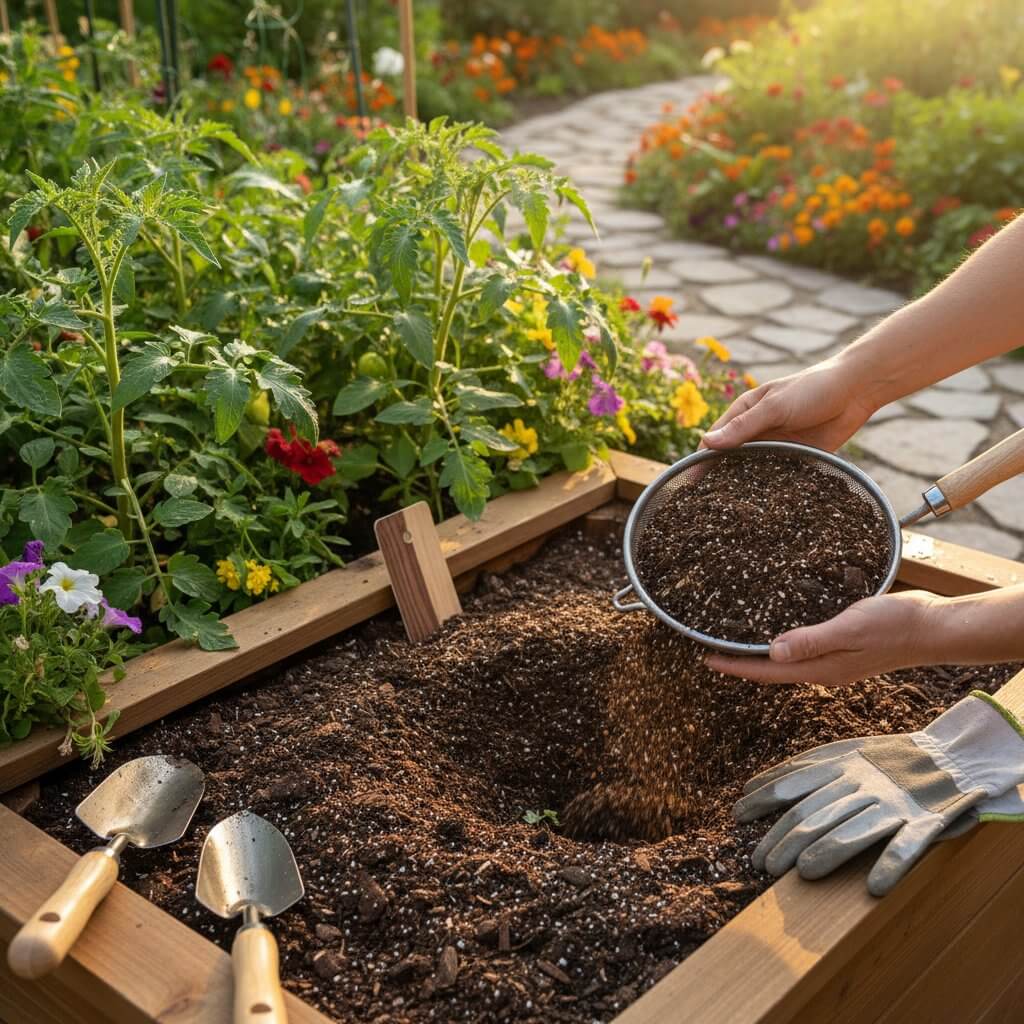
Healthy gardens depend on more than sunlight and regular watering. The soil around plant roots affects drainage, moisture retention, nutrient availability, and how easily roots can expand through the growing area.
Garden Mix combines topsoil, compost, and sandy loam to create a balanced planting medium for vegetable gardens, flower beds, raised beds, and other landscape projects. Understanding how this mixture works, when to use it, and how much you need can help create better growing conditions from the beginning.
Key Takeaways
- Garden Mix combines topsoil, compost, and sandy loam to balance structure, organic matter, and drainage.
- It is well suited to vegetable gardens, flower beds, raised beds, and many ornamental planting areas.
- Garden Mix is different from compost because it functions as a complete planting medium rather than only a soil amendment.
- Incorporating new soil into the existing surface can help avoid an abrupt boundary between soil layers.
- Correct application depth depends on whether you are improving an existing garden or creating an entirely new planting area.
- Soil moisture, drainage, sunlight, and plant requirements should still guide garden maintenance after installation.
What Is Garden Mix?
Garden Mix is a blended planting soil designed to provide plants with a balanced growing environment.
ARS Landscape Materials & Supply Garden Mix combines topsoil, compost, and sandy loam. These ingredients perform different functions within the soil.
Topsoil contributes mineral material and helps provide physical structure. Compost adds organic matter, while sandy loam contributes texture that can support drainage and workability.
Rather than relying heavily on one soil component, the blend creates a more versatile growing medium for landscaping applications.
This makes Garden Mix useful when the existing soil is poor, when additional planting depth is required, or when a completely new garden bed is being established.
What Is Garden Mix Made Of?
Each ingredient in Garden Mix contributes to the conditions surrounding plant roots.
|
Garden Mix Component |
Primary Function |
Why It Matters |
|
Topsoil |
Provides mineral soil and structure |
Supports roots and creates soil volume |
|
Compost |
Adds organic matter |
Supports soil biology and nutrient cycling |
|
Sandy loam |
Improves texture |
Helps balance drainage and moisture movement |
A mixture of these materials can provide advantages over using any one ingredient alone.
Pure compost, for example, contains substantial organic matter but is generally better used as an amendment than as the only planting medium.
Topsoil provides structure but varies considerably in quality and composition. Combining it with compost and sandy loam can create a more balanced soil for garden applications.
Benefits of Using Garden Mix
The main advantage of Garden Mix is that it gives plants a prepared growing medium rather than forcing them to establish entirely within poor or compacted soil.
Roots require a combination of moisture, oxygen, nutrients, and physical space. A suitable soil mixture helps create those conditions.
Garden Mix can also simplify new landscaping projects because the soil components have already been blended together.
Instead of purchasing topsoil and Compost separately and determining how much of each material to combine, gardeners can use a prepared mix for suitable planting applications.
Garden Mix Supports Root Development
Strong root systems are essential for healthy plants.
Roots need enough pore space to move through the soil and access water and nutrients. Dense, heavily compacted ground can restrict root expansion and make it difficult for water and air to penetrate evenly.
A balanced Garden Mix provides a more workable growing medium.
This is particularly helpful when establishing vegetables, annual flowers, perennials, or ornamental plants in areas where the original soil is difficult to cultivate.
However, new Garden Mix should not always be treated as an isolated layer.
When practical, blending or transitioning the new material into the upper portion of the existing soil can help roots move beyond the newly installed planting medium as plants mature.
Garden Mix and Water Management
Good garden soil needs to manage two competing needs. It must hold enough moisture for roots while allowing excess water to move away.
Soil that drains too quickly may require frequent watering. Soil that remains saturated can create unfavorable conditions for many plants.
The sandy loam and organic matter in Garden Mix help create a soil texture that can support balanced moisture management.
Actual drainage still depends on the entire site.
If a garden bed sits above heavily compacted clay or is located in a low area where water naturally collects, replacing the upper soil with Garden Mix will not necessarily solve the underlying drainage problem.
Evaluate grading and drainage before installing a large new planting area.
Garden Mix vs. Compost vs. Planter’s Mix
Different soil products are designed for different purposes.
Choosing according to the project can prevent unnecessary material use and create more appropriate growing conditions.
|
Product |
Primary Purpose |
Common Applications |
|
Garden Mix |
Complete garden growing medium |
Vegetable beds, flowers, raised beds |
|
Compost |
Soil amendment |
Improving existing garden soil |
|
Planter’s Mix |
Landscape planting medium |
Trees, shrubs, grass, planting areas |
|
Existing topsoil |
Base soil layer |
Improved according to site conditions |
If your existing garden already has sufficient soil but needs more organic matter, compost may be enough.
If you are creating a new vegetable or flower bed, Garden Mix may provide a more complete starting point.
ARS Planter’s Mix may be more appropriate for other landscape applications involving trees, shrubs, grass, and broader planting areas.
Matching the product to the project is more effective than assuming one soil blend is ideal for every plant.
Where Can You Use Garden Mix?
Garden Mix is most useful in areas where plant growth is the primary goal.
It can be considered for vegetable gardens, flower beds, raised beds, ornamental planting areas, and other spaces that require a suitable growing layer.
Raised beds are particularly straightforward because the required soil depth can be measured before filling the structure.
Existing garden beds may require less material. In those cases, Garden Mix can be used to replenish lost soil or improve planting depth rather than completely replacing the existing soil.
Garden Mix should not be used as structural fill for major grading work. If the goal is raising land elevation or filling deep depressions, a more appropriate fill material should typically establish the lower layers.
How to Use Garden Mix Effectively
Start by preparing the planting area.
Remove weeds, large roots, construction debris, and other unwanted material that could interfere with installation. If the existing soil is severely compacted, loosening the upper surface before adding new soil can help create a better transition between layers.
Spread the Garden Mix evenly across the area.
For an existing garden, the material may be incorporated into the upper several inches of soil. For new raised beds or planting areas, a deeper layer may be required depending on the plants being grown.
Avoid automatically applying the same depth to every project.
Shallow-rooted annuals and deeper-rooted vegetables can have different soil requirements. The existing soil beneath the Garden Mix also affects how much new material is necessary.
How Much Garden Mix Do You Need?
Estimating the correct amount before ordering helps prevent unnecessary leftover material.
For rectangular areas, calculate:
Length × Width × Depth = Volume
If all measurements are in feet, divide the result by 27 to convert cubic feet into cubic yards.
|
Area |
Garden Mix Depth |
Approximate Volume |
|
100 sq. ft. |
3 inches |
0.9 cubic yards |
|
100 sq. ft. |
6 inches |
1.9 cubic yards |
|
200 sq. ft. |
6 inches |
3.7 cubic yards |
|
500 sq. ft. |
4 inches |
6.2 cubic yards |
These are approximate planning figures.
Raised beds can be calculated using their full internal dimensions, while irregular beds may need to be divided into smaller sections for a more accurate estimate.
Allowances may also be needed for settling and final grading.
Maintaining Garden Mix After Installation
Installing quality soil is only the beginning.
Monitor moisture after planting rather than following a fixed watering schedule without considering weather and soil conditions. Newly installed beds may behave differently from the soil that was previously in the area.
Organic matter also changes gradually over time.
As plants grow and garden soil is cultivated, additional compost may eventually be useful for maintaining soil quality. That does not mean Garden Mix needs to be replaced each season.
Adding appropriate amendments based on actual soil conditions is usually more practical than rebuilding an established garden bed.
Mulching can also help protect the soil surface and reduce moisture loss around many plants.
Common Garden Mix Mistakes to Avoid
One common mistake is assuming Garden Mix can correct poor site drainage on its own.
High-quality planting soil still depends on appropriate grading and drainage beneath the bed.
Another mistake is creating a small pocket of improved soil surrounded by severely compacted ground. Roots may eventually encounter the surrounding soil and struggle to expand.
Overwatering is also possible.
Because soil containing organic matter may hold moisture differently from native soil, irrigation should be adjusted according to actual moisture levels rather than habit.
Finally, avoid adding unnecessary amendments immediately after installing a prepared Garden Mix. Give plants and soil conditions time to establish before assuming additional products are required.
Frequently Asked Questions
What components make up Garden Mix?
Garden Mix combines topsoil, compost, and sandy loam. Together, these materials provide mineral structure, organic matter, and a workable texture suited to many garden applications.
Can Garden Mix be used for all types of plants?
Garden Mix is versatile and can support many vegetables, flowers, and ornamental plants. However, plants with specialized soil, drainage, or pH requirements may need a different growing medium or additional preparation.
Is Garden Mix better than compost?
Neither product is universally better because they serve different purposes. Garden Mix functions as a more complete planting soil, while compost is mainly used to add organic matter to existing soil.
If you are creating a new garden bed, Garden Mix may be more appropriate. If the existing soil only needs improvement, compost may be sufficient.
How deep should the Garden Mix be?
The correct depth depends on the project and the existing soil. A shallow layer may be enough when improving an established bed, while a new raised bed or planting area may require substantially more soil.
Consider the root depth of the plants you intend to grow before deciding how much material to install.
Create Better Growing Conditions with Garden Mix
Garden Mix provides a practical foundation for gardens because it combines several soil components into one planting medium.
Topsoil provides structure, compost adds organic matter, and sandy loam helps create a workable texture. Together, these materials can support drainage, moisture management, root development, and healthy plant growth when they are used in an appropriate location.
The best results come from matching the soil to the project, preparing the site correctly, and managing water according to actual garden conditions.
Learn More about Garden Mix from ARS Landscape Materials & Supply and determine how much material your next garden project may require.