
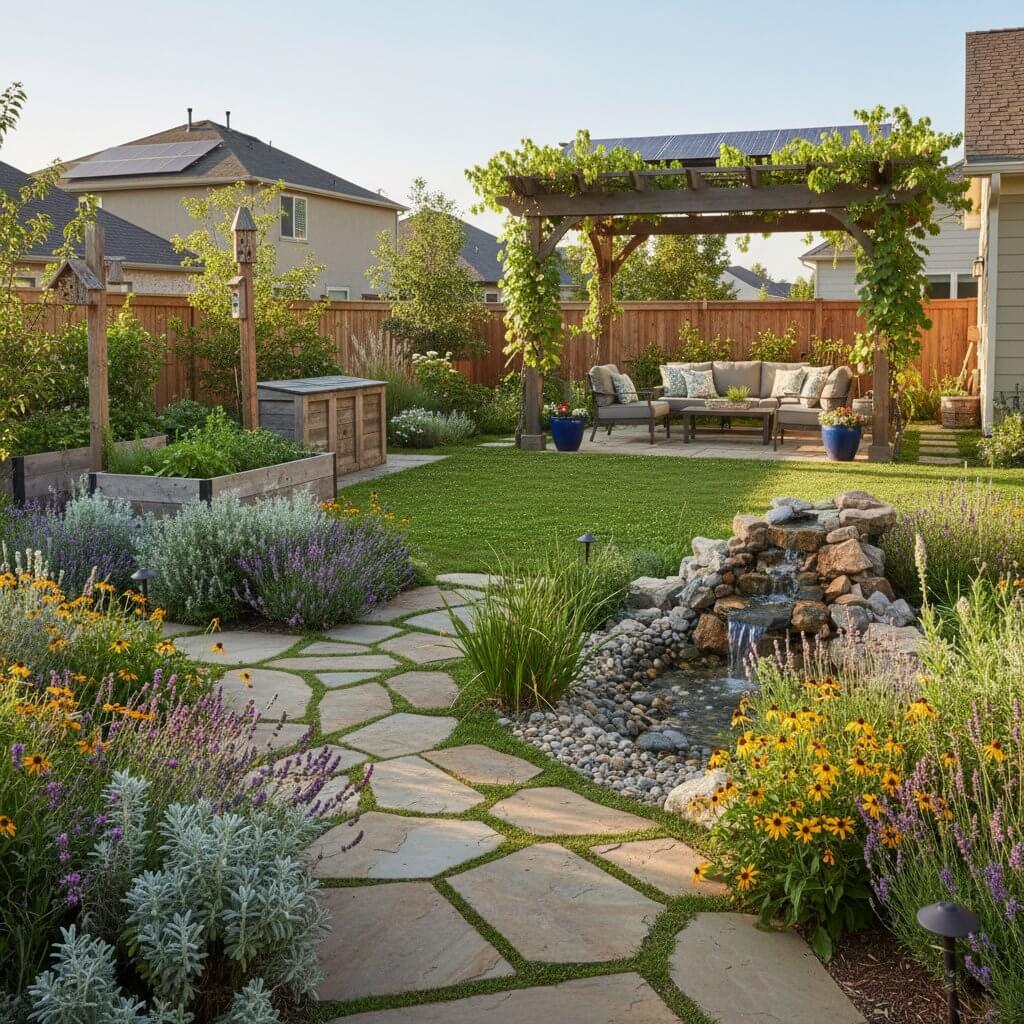
Sustainable landscaping focuses on creating outdoor spaces that use water, soil, plants, and landscaping materials more efficiently. Instead of relying on constant irrigation, frequent soil replacement, or unnecessary chemical inputs, a sustainable landscape works with local conditions to support healthier plants and reduce ongoing maintenance.
For homeowners and property managers in the Denver area, this can mean improving soil with compost, choosing plants suited to Colorado’s climate, conserving moisture with mulch, and designing irrigation around actual plant needs. ARS Landscape Materials & Supply provides soil products and landscape materials that can support many of these practices.
Key Takeaways
- Sustainable landscaping starts with healthy soil and efficient water management.
- Compost can add organic matter and improve existing garden soil.
- Garden mix can provide a better foundation for new planting areas.
- Native and climate-adapted plants generally require less intervention once established.
- Mulch can conserve soil moisture, reduce weed pressure, and protect the soil surface.
- Sustainable landscaping works best as a combination of practices rather than relying on one material or technique.
What Is Sustainable Landscaping?
Sustainable landscaping is an approach to designing and maintaining outdoor spaces while making efficient use of natural resources.
It considers how plants, soil, water, climate, and landscape materials work together rather than treating each part of the property separately.
A sustainable landscape does not have to look wild or unfinished. It can include lawns, flower beds, trees, shrubs, patios, and other traditional landscape features.
The difference is in how those features are planned and maintained.
For example, a lawn may be reduced in areas where grass is difficult to maintain. Garden beds can be improved with organic matter, while plants can be grouped according to similar irrigation needs.
These changes can reduce unnecessary maintenance while helping the landscape adapt better to local conditions.
Why Sustainable Landscaping Matters in Colorado
Denver-area landscapes face conditions that make efficient planning especially valuable.
Periods of dry weather, strong sunlight, temperature changes, and varying soil conditions can make landscapes difficult to maintain when plants and materials are poorly matched to the site.
Water use is one of the biggest considerations.
Plants that require frequent irrigation may struggle in exposed areas, while overwatering can create its own problems, including poor root development and unnecessary runoff.
Soil conditions also vary considerably. Some properties contain dense or clay-heavy soil, while others have compacted construction soil or planting areas that have lost organic matter over time.
A sustainable approach begins by identifying these conditions before adding more plants, soil, or irrigation.
Start Sustainable Landscaping with Healthy Soil
Healthy soil provides plants with water, oxygen, nutrients, and space for roots to develop.
When soil is compacted or low in organic matter, plants may require more frequent watering and additional inputs to compensate for poor growing conditions.
Improving the soil first can make the rest of the landscape easier to manage.
|
Soil Condition |
Sustainable Improvement |
|
Low organic matter |
Add appropriate compost |
|
Poor planting soil |
Use a suitable garden mix |
|
Compacted surface soil |
Improve structure before planting |
|
Fast-drying soil |
Add organic matter and mulch |
|
Poor drainage |
Address grading or drainage before adding amendments |
The correct approach depends on the existing conditions. Adding large amounts of material without first identifying the problem can waste resources and may not improve plant performance.
Improve Existing Soil with Aged Compost
Compost is one of the most useful materials for sustainable soil management because it improves existing soil instead of requiring the entire planting area to be replaced.
ARS aged garden compost can be incorporated into vegetable gardens, flower beds, and other planting areas where additional organic matter is needed.
Compost can help improve soil structure, support biological activity, and influence the way soil manages moisture.
In sandy soil, organic matter can help increase moisture retention. In dense soil, compost can improve workability and contribute to better soil structure over time.
Compost should still be used according to actual soil conditions.
More is not automatically better, especially in established garden beds that may already contain substantial organic matter.
A moderate application incorporated into the upper soil or used as a light top dressing is often more appropriate than repeatedly adding thick layers.
Use Garden Mix for New Planting Areas
When creating a new garden bed, the existing soil may not provide enough depth or quality for healthy plant growth.
A balanced Garden Mix can provide a more complete growing medium for vegetables, flowers, raised beds, and other planting areas.
Garden mix differs from compost because it contains mineral soil as well as organic material. This gives roots a structured growing medium while still providing organic matter.
Using the correct product also prevents unnecessary material use.
If you only need to improve an existing bed, compost may be sufficient. If you are creating a new growing area from the ground up, garden mix may be the more practical option.
Choose Plants That Fit the Site
Plant selection has a major influence on how much water and maintenance a landscape requires.
Plants suited to Denver’s climate and the conditions of a specific property generally require less adjustment than plants that prefer very different environments.
Native plants can be useful because they are adapted to regional conditions, but native status should not be the only consideration.
Sun exposure, mature plant size, drainage, soil type, irrigation availability, and the amount of wind an area receives should all influence plant selection.
A plant that prefers moist shade will still struggle in an exposed, south-facing location even if it performs well elsewhere in the region.
Group plants with similar water requirements whenever possible. This allows irrigation to be adjusted by planting zone instead of applying the same amount of water everywhere.
Reduce Water Loss with Mulch
Mulch is a simple way to improve moisture management around many landscape plants.
A suitable mulch layer covers exposed soil, reducing direct sunlight and slowing surface evaporation. It can also limit weed growth, which reduces competition for water.
Organic mulch can gradually contribute material to the soil as it breaks down, although it should not be treated as a direct substitute for compost.
Mulch depth matters.
Applying too little may provide limited coverage, while piling excessive material around plant stems or tree trunks can trap unwanted moisture.
Keep mulch away from direct contact with trunks and woody stems. Spread it across the root zone instead of creating a mound immediately around the plant.
Make Irrigation More Efficient
Sustainable landscaping does not necessarily mean eliminating irrigation.
The goal is to provide water where and when plants need it without creating unnecessary waste.
Drip irrigation can be useful for garden beds, shrubs, and other targeted planting areas because it delivers water closer to the root zone.
Sprinkler systems should be checked periodically for damaged heads, overspray, blocked patterns, and areas receiving more or less water than intended.
Watering schedules should also change with the season.
A system that runs at the same frequency throughout spring, summer, and fall may deliver more water than necessary during cooler periods.
Deep, appropriate watering can encourage roots to develop beyond the immediate soil surface, depending on the plant and soil conditions.
Use Rainwater Responsibly
Rainwater can supplement irrigation when collection and use are appropriate for the property and local requirements.
Rain barrels and similar systems can capture water from roof runoff for later landscape use.
Even without a collection system, landscapes can be designed to make better use of rainfall.
Proper grading, healthy soil, and planted areas can help water infiltrate where appropriate instead of immediately running off hard surfaces.
However, water should not be intentionally directed toward foundations or areas where drainage could cause damage.
Site drainage should always be considered as part of sustainable landscape planning.
Reduce Unnecessary Lawn Areas
Lawns can be useful for recreation, pets, and open space, but turf does not need to occupy every unused section of a property.
Areas that are difficult to irrigate, steeply sloped, heavily shaded, or rarely used may be better suited to alternative landscaping.
Replacing selected lawn sections with planting beds, mulch, groundcovers, or other appropriate materials can reduce mowing and simplify irrigation.
This does not require removing all turf.
A more practical approach is to keep lawn where it serves a clear purpose and reconsider areas that consistently require excessive maintenance.
Plan Materials Before You Buy
Sustainable landscaping also involves reducing wasted materials.
Before ordering soil, compost, or mulch, measure the area and estimate the required application depth.
For rectangular areas:
Length × Width × Depth = Volume
If measurements are in feet, divide total cubic feet by 27 to estimate cubic yards.
Accurate estimating can reduce leftover material and unnecessary transportation.
|
Material |
Common Planning Consideration |
|
Compost |
Application depth and existing soil condition |
|
Garden mix |
Bed dimensions and final soil depth |
|
Mulch |
Surface area and desired coverage |
|
Fill material |
Required elevation and compaction |
Large or irregular areas may require additional calculations. Breaking the project into smaller sections often makes estimates easier.
Think About Long-Term Maintenance
A sustainable landscape should become manageable over time rather than creating a constant maintenance burden.
Before installing a plant, consider its mature size. A shrub that becomes too large for its location may require repeated pruning or eventual removal.
The same principle applies to irrigation, soil, and landscape materials.
Designing access to irrigation components makes future repairs easier. Choosing the appropriate soil before planting can reduce the need for repeated amendments.
Sustainability often comes from making better decisions at installation rather than adding more products later to correct avoidable problems.
Frequently Asked Questions
What are the main benefits of sustainable landscaping?
Sustainable landscaping can improve water efficiency, soil health, plant performance, and long-term maintenance. It also encourages property owners to select materials and plants according to actual site conditions instead of relying on unnecessary inputs.
How does compost support sustainable landscaping?
Compost adds organic matter to existing soil and can improve structure, moisture management, and biological activity. This allows gardeners to improve soil already on the property rather than replacing it entirely.
Is sustainable landscaping the same as xeriscaping?
Not exactly. Xeriscaping focuses heavily on water-efficient landscape design, particularly in dry climates. Sustainable landscaping is broader and may include water conservation, soil improvement, responsible material use, climate-appropriate plants, and reduced maintenance.
How can ARS Landscape Materials & Supply support a sustainable landscape?
ARS Landscape Materials & Supply provides materials such as compost and garden mix that can be used to improve soil and establish planting areas. Selecting the appropriate material and ordering only the quantity required can support a more efficient landscaping project.
Build a Landscape That Works with Your Property
Sustainable landscaping is less about following a single formula and more about making each part of the landscape work efficiently.
Start with the soil, choose plants that match the site, manage irrigation according to actual need, protect exposed soil with mulch, and purchase landscape materials based on measured project requirements.
These practices can create an outdoor space that remains attractive while requiring fewer corrective measures over time.
ARS Landscape Materials & Supply provides landscape materials for Denver-area homeowners, landscapers, and property managers working on soil improvement, new planting areas, and other outdoor projects.
Explore Sustainable Options and choose materials that fit the needs of your landscape.